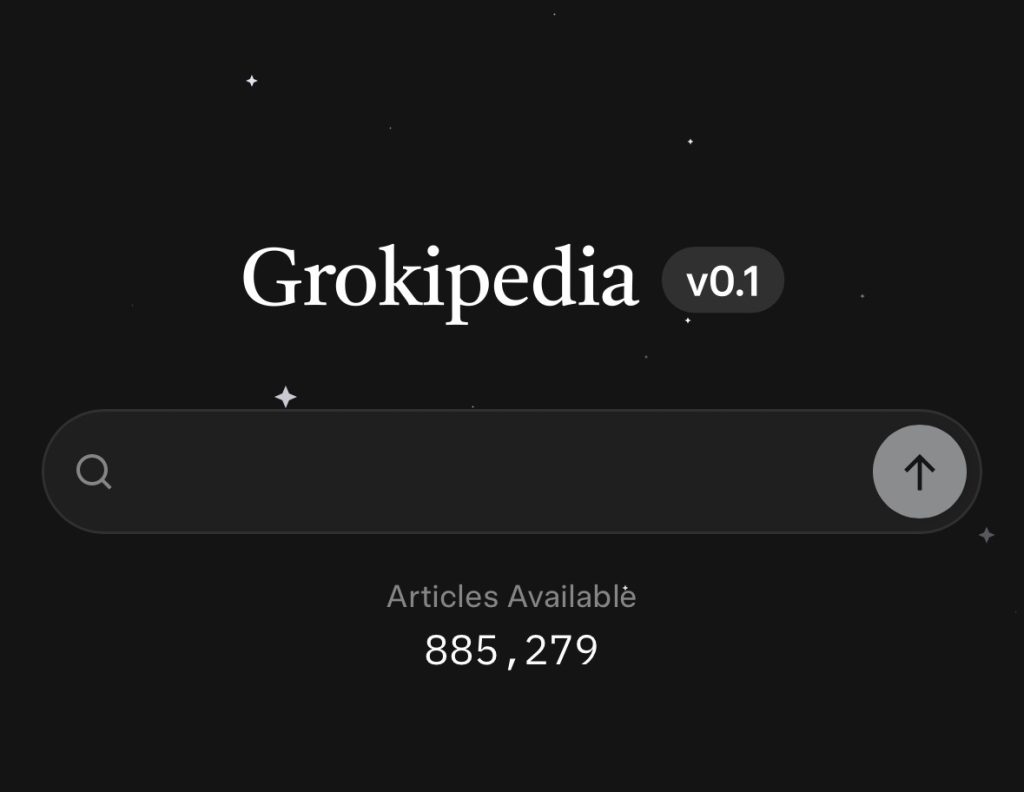
Today at TechReft, we were discussing Grokipedia, the new AI-powered online encyclopedia developed by xAI, the artificial intelligence company founded by Elon Musk. Launched in late October 2025 the project has drawn global attention for its ambition to compete directly with Wikimedia Foundation’s Wikipedia.
What is Grokipedia?
Grokipedia is described as an AI-generated encyclopedia where content creation and editing are predominantly handled by the Grok language model developed by xAI. Its launch version, labelled “v0.1,” reportedly includes around 885,000 articles at the time of debut, a number that is significantly lower than Wikipedia’s multi-million article corpus. Unlike Wikipedia’s volunteer-driven, crowdsourced model, Grokipedia takes an automation-first approach, with limited transparency around human editorial oversight.
Key Features and Design
- The user-interface of Grokipedia presents a familiar layout: a search-bar front and centre, article pages with headings and subheadings styled similarly to Wikipedia.
- Many entries include a notice that the content was “adapted from Wikipedia” under a Creative Commons licence.
- Grokipedia’s articles often bear a label indicating that they were “fact-checked by Grok,” signalling the AI model’s role not just in writing but in verification.
- At launch the platform hit capacity issues, with users reporting crashes and incomplete access to editing tools.
Why Was It Created?
The motivations behind Grokipedia stem from several strategic and ideological factors:
- Elon Musk has repeatedly criticised Wikipedia for what he perceives as liberal editorial bias, positioning Grokipedia as a “truthful and independent alternative.”
- From a business and technology perspective, structuring a large, AI-powered knowledge base gives xAI and Musk further control over the architecture of online information and its integration into other AI services.
- As the AI ecosystem evolves, having a proprietary encyclopedia offers potential utility as a training or reference dataset for models, chatbots and knowledge-graph systems.
Strengths and Opportunities
- The AI-first model promises rapid article creation, updates and scalability beyond traditional volunteer models.
- There is potential for deeper integration with search, AI assistants and dynamic content generation built on the knowledge base.
- For global audiences including tech readers, Grokipedia offers a fresh frontier in how information might be structured, surfaced and consumed in the AI era.
Risks and Challenges
- Early analysis has found that many articles are near-verbatim copies of Wikipedia. This raises concerns about originality, licensing compliance and value-add.
- The model of automated fact-checking by AI carries inherent risks of hallucination, bias and opaque editorial processes. Wired flagged entries with incorrect claims tied to ideological narratives.
- Wikipedia’s self-governed, transparent editing community and their mechanisms for accountability and dispute moderation are well-established. Grokipedia, by contrast, offers less clear governance, raising questions about trust and reliability.
- Competing with Wikipedia’s massive ecosystem, multi-lingual reach, established citations and public trust is a steep undertaking.
What It Means for Global Tech Audiences
For TechReft’s audience of tech professionals, content creators and international readers the emergence of Grokipedia carries several implications:
- The way knowledge is packaged online may shift from human-curated towards AI-driven models, affecting how information is referenced, cited and validated.
- Content strategy and SEO may need to adapt: alternative knowledge bases such as Grokipedia may start influencing search results and metadata, especially in AI-generated summaries.
- Readers and researchers should remain vigilant about source transparency, credentials of articles and editorial provenance when using new platforms for information.
- For African and global tech markets the idea of an AI-powered, potentially multilingual encyclopedia could open new access pathways to structured knowledge—but the reliability and editorial fairness must be scrutinised.